


SERIES: Rapid Release Theory
HOW IT ACTUALLY WENT.
In this series so far, I've covered why I opted for Rapid Release, Two Truths and a Lie about the process, and I even covered the costs of it. For this post, I wanna break down nitty gritty of what actually happened during the release months, and if I felt the process overall was positive. To decide if it was, We'll have to look at some hardcore numbers.
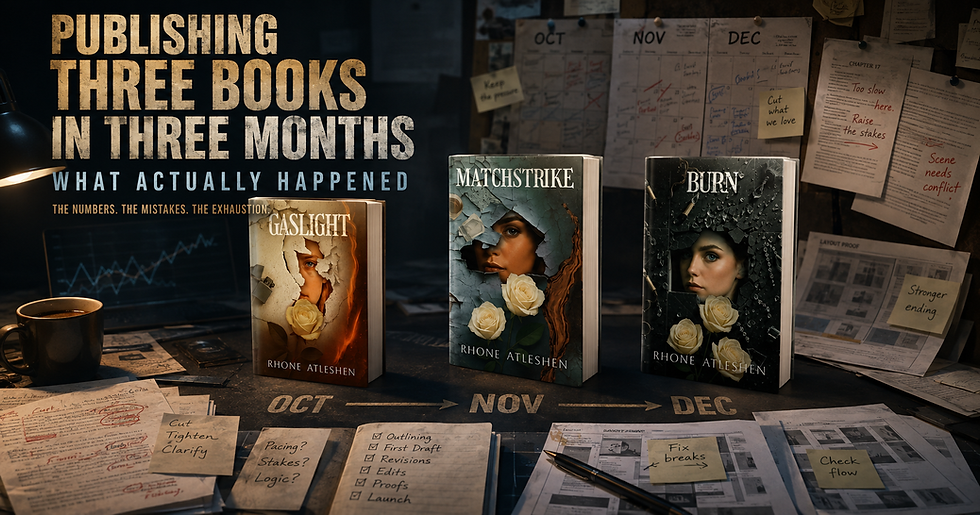
REMEMBER, my plan was to use rapid release to generate repeated visibility for a brand-new pen name while giving readers the opportunity to binge the entire trilogy without waiting six months—or several infuriating years—between books. I wanted to build momentum!
Alas, while I may have done that, it also created mistakes, exhaustion, and approximately enough royalties to confirm that I was technically selling books—but not enough to suggest I should begin browsing private islands. So let's get down to brass tax.
The Launch Numbers
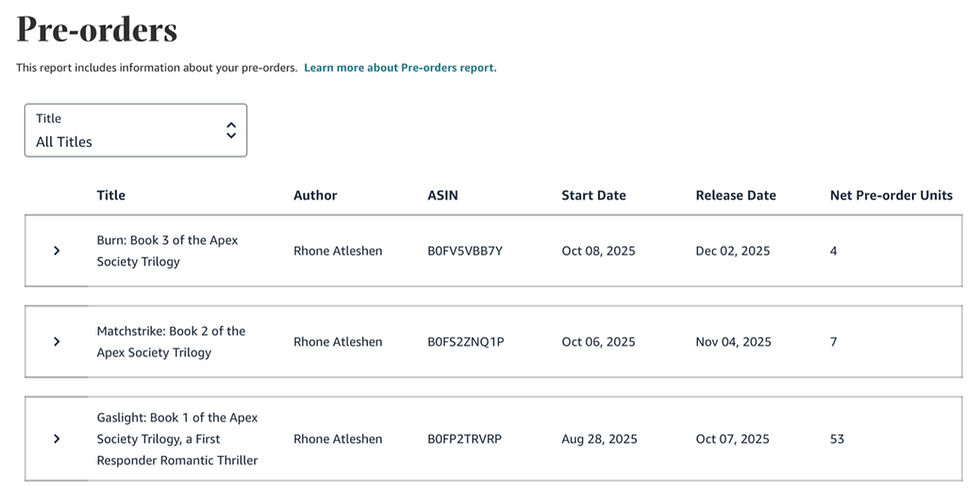
Before release day, the trilogy accumulated a total of 64 preorders:
Gaslight: 53
Matchstrike: 7
Burn: 4
No, those numbers did not increase as the series progressed. I had a longer RUNWAY for my marketing team to do their work, hence Gaslight had the better numbers. But with barely 30 days between launches, there was not enough time to BOTH market existing books AND push pre-orders for subsequent releases. I believe this held back the numbers for books 2 and 3.

However, preorders were only one portion of the picture. From October 31 through December 31, KDP processed 478 units across my account. The visible trilogy breakdown accounted for 476 of those:
Gaslight: 23 units during that reporting window
Matchstrike: 223 units
Burn: 230 units
That date range matters. Because the report begins on October 31, it does not include Gaslight’s October 7 launch or its initial preorder deliveries. Comparing those three totals as if they represent identical launch periods would therefore be misleading, but by December 29, the trilogy had also accumulated 19,144 Kindle Unlimited page reads:

Gaslight: 9,694 pages
Matchstrike: 5,112 pages
Burn: 4,338 pages
There is, however, one tiny problem with that graph. October is essentially empty. Was nobody reading Gaslight?
Not exactly. I forgot to enroll it in Kindle Unlimited.
OOPS
I launched a rapid-release trilogy partly to generate visibility through Amazon—and then forgot to activate one of Amazon’s largest reader-discovery tools.
The Reviews Were Positive—but Scarce
The reviews that arrived were encouraging. Readers liked the books, understood what I was trying to do, and responded positively to the characters, suspense, romance, and larger trilogy arc. There simply weren’t very many of them. Across all three books, I received roughly ten early reviews scattered throughout the trilogy. That was enough to reassure me that the books were connecting with readers. It was not enough to create the kind of visible social proof that makes an unfamiliar shopper feel completely comfortable taking a chance on an unknown author.
Rapid release gave readers three opportunities to discover me. It did not magically make those readers leave reviews.
The Money Was…Nominal
The books sold.
Pages were read.
Readers progressed through the trilogy.
But during the launch period, the actual royalties amounted to only a few hundred dollars.
That distinction matters because sales activity can look exciting on a graph without representing significant income. Units, page reads, rankings, social engagement, and royalties all measure different things.
In my case, that meant the launch produced activity, but did not recover my investment.
More importantly, it certainly did not pay me for the months of labor involved in producing and launching three books. But that's okay...and I'll get to WHY that was okay below...so stick with me.
The Social Platforms Grew Faster Than the Royalties
The clearest immediate success happened outside the KDP dashboard. My social media platforms took off. Launching three connected books gave me a constant supply of material:
Three covers
Three couples
Three sets of tropes
Three releases
Three batches of excerpts
Three opportunities to introduce readers to the Apex Society
Instead of appearing online once to announce a debut and then disappearing into the wilderness to write the next book, I had something new to discuss every day, of every week, of every month. That repeated activity helped establish the Rhone Atleshen author brand and gave me the beginnings of a real follower base. One platform gained 1200 followers within 3 months, another platform achieved 400 and a third one 500. Those followers did not instantly translate into equivalent book sales. Audience growth and customer conversion are not the same thing. Still, the platform growth became an asset I could continue building after the launch ended. So while, the royalties were nominal...the visibility was not.
Meanwhile, Behind the Scenes…
Whilethe public saw three polished releases arriving one after another. I saw the publishing equivalent of an eighteen-car pileup.
At one point, I was actively:
Working on the cover design for one book
Formatting another book’s interior and managing its metadata
Editing the third book
Marketing two of them simultaneously
Engaging in social media as much as I could
actively learning all I could on book marketing
Each task required a completely different part of my brain.
Developmental editing required sustained attention to story, character, continuity, and pacing. Cover work required visual judgment and market positioning. Formatting and metadata required technical accuracy. Marketing required creativity, consistency, analysis, and the ability to act enthusiastic on command.
Switching among those jobs constantly was a nightmare.
And because the books were interconnected, a late change in one manuscript could create consequences elsewhere. One adjustment became three checks, two corrections, another uploaded file, and at least one moment of wondering why I had done this to myself.
Rapid release did not mean completing one publishing cycle and beginning another.
It meant stacking three publishing cycles on top of one another and attempting to identify which fire was currently making that smell.
But...did the Plan Work?
Yes—but not in every way I had hoped.
The trilogy launched on schedule.
The books found readers.
Kindle Unlimited activity increased as more of the series became available.
Readers could move directly from one story to the next.
My social platforms grew, and the new author brand began developing an audience.
But the launch did not produce substantial income. Reviews accumulated slowly. Preventable mistakes slipped through because my attention was divided across too many simultaneous responsibilities. By the end of the process, I was wrecked.
Rapid release created momentum, but it also revealed something important:
Momentum, profitability, and sustainability are not the same thing...so I have learned.
I succeeded in putting three books into the world in three months. I don't REGRET doing so.
Whether doing so was the smartest possible use of my time, money, and remaining sanity is a slightly different question.
And yes—that deserves another post.
⭐ Craft the story.
Face the consequences.
NEVER STOP READING!
— Rhone
Join my newsletter for future books, publishing confessions, and additional evidence that mistakes were made.
Visit my Amazon Author storefront to explore The Apex Society Trilogy.
As an Amazon Associate, I earn from qualifying purchases. Thanks for the tip!



Comments