


SERIES: Rapid Release Theory
When I decided to launch a new pen name, build an author platform, and publish The Apex Society Trilogy, I wasn't working with a large and profitable back-catalogue. I had nothing but spit, grit, and bullsh*t to muscle my way forward. As such, I had to make some hard and fast decisions on how to work within the budget I had for maximum impact and the magic number, was $6,000.
That's it.
6k
Not the starting budget.
Not the first round of funding.
Not an amount I could supplement if surprises popped up.
Six thousand dollars was what I had set aside to turn three rough manuscripts into professionally published books and introduce Rhone Atleshen to the world.
It was sink or swim–on that amount–and nothing else.
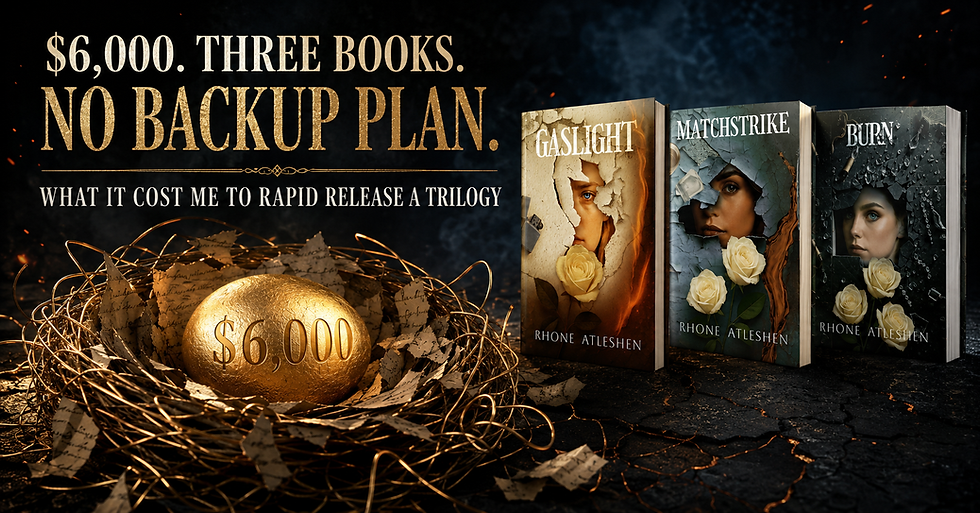
That starting nest egg gave me enough money to invest in the trilogy, but not enough to make careless decisions. I knew I couldn’t outsource every task. I couldn’t subscribe to every platform marketed as essential for indie authors or chase every promotional opportunity or fix every inconvenience by paying someone else to handle it. Every expense had to justify taking money away from something else and that reality shaped my entire publishing philosophy:
Spend money where readers will see and feel the difference. Scrimp everywhere else.
Before purchasing anything, I asked myself a series of questions.
Could I do this myself?
Did I know someone that could get the job done?
If not, was there a cheap option that would accomplish the goal?
Every purchase decision was filtered through those criteria and more than anything, if I truly needed to spend money, could I make it a one-time purchase instead of another monthly subscription? Why, because $10 dollars per month doesn’t look frightening. Neither does twenty. But authors are offered an endless collection of tools, memberships, platforms, upgrades, and services—each promising to make publishing easier. Stack enough of those “small” subscriptions together, and they quietly begin consuming the budget meant to produce the actual books. And my budget was fixed, finite, and frugal AF. Whenever possible, I looked for tools I could purchase once and continue using WITHOUT SACRIFICING QUALITY. As I stated before:
The goal wasn’t to make publishing free.
The goal was to funnel the money toward the parts I couldn't—or shouldn't—fake.
What I Spent the Money On
So for me, since I already owned my MacBook, and Scrivener (the end all be all software for development IMHO), It came down to spending my funds on the major investments that would partner with my previously stated algorithmic goals by focusing on the spit and polish:
Professional editing
Professional cover design
A marketing team to fuel the launch
Thrice did I spend it and thrice was it well spent -- and here's why I put the money where I did.
Editing
I had written all three books, but completing a manuscript and preparing it for publication are not the same thing. Because the larger Apex storyline continued across the trilogy, the editing process wasn’t limited to improving sentences inside three separate books. Changes made to Gaslight could affect Matchstrike. Adjustments to Matchstrike could create consequences inside Burn. I needed a professional editor who could help strengthen each book while also understanding the trilogy as a connected whole. And yes I could use (and did) Grammarly and Auto-Crit and other software services, at the end of the day, I NEEDED a good set of HUMAN eyes to help make sure these babies felt finished, consistent, and clear.
Cover Design
I am smart enough to know where my strengths lie, and that's in words....not art. And I knew before anyone knew the Wilder brothers, the Apex Society, or what waited inside those pages, they would see the packaging. I wanted three covers that worked individually but also looked unmistakably connected as a trilogy. They had to signal danger, romance, suspense, and an escalating series while still being legible at Amazon-thumbnail size.
That required professional design.
I could learn many aspects of independent publishing. I was not going to pretend that owning Canva made me a professional cover designer.
Marketing
I was not simply releasing three books. As mentioned before, I was launching a pen name and an author platform with essentially no established readership behind either one.
The books needed visibility, and I needed help building awareness while I was simultaneously editing, approving covers, preparing releases, and managing every other piece of the rapid-release schedule.
Could I have attempted all of the marketing myself? Yes.
Could I have done it well while managing everything else? No.
The marketing team helped spread the word while I handled the parts of publishing that could not be handed off. They had established reader groups to help build my platform counts, and they had the knowledge and access to utilize seasonal ad work that I couldn't begin to dip my toe into. And at the end of the day, it would never matter how GOOD my books were, if they were INVISIBLE.
Everything Else Had to Fit Around Those Priorities
Once editing, cover design, and marketing claimed their places in the budget, everything else had to be handled as inexpensively as possible.
I searched for cheap resources.
I compared before purchasing.
I learned new systems.
I handled tasks myself.
I sacrificed sleep and sanity.
I loved every second!
And to be clear, the $6,000 nest egg forced me to decide what kind of publisher I wanted to be...but it was a hard road to hoe. I wasn’t trying to purchase the appearance of legitimacy. I was trying to create professional books, package them appropriately, and help them reach readers. Everything that supported those goals received consideration. Everything else had to prove it belonged.
As for HOW I did it - networking, shop around, take advantage of any and all new client discounts. There are TONS of talented designers, editors, and marketing guru's who are hungry for work and WILLING to work with small start-up indie authors. I rolled up my sleeves, and left no stone unturned in trying to find them all. My editor came from an online conference that offered a free 1 hour consult. We met, meshed well, and negotiated terms. Marketing team, similar deal. Cover designer, friend of a friend who wanted to do some side work and was hungry to get into book covers. ALL OF THESE WERE DONE on my shoe-string budgets, and then I made sure to praise them from the rafters on social media, offering them all raving reviews for their own marketin purposes, and have further referred them out or returned to them time and again.
Ultimately, Did it work?
Simply -- yes.
My books have won awards, achieved #1 in their amazon categories several times over, and the reviews keep coming in. THAT'S THE WIN! I produced something evergreed and it's living and breathing while I move on to create the next thing so my budget worked.
Did it earn back the investment?
That answer belongs in another post. ;-)
For now, the honest answer to what it cost me to rapid release three books is simple. 6k, elbow grease, a slight case of writerly insanity, and a unyielding belief that my work deserved to shine in the world.
Follow along for more!
⭐ Craft the story.
Face the consequences.
NEVER STOP READING!
— Rhone
Join my newsletter for future book updates, and visit my Amazon Author storefront for funsies.
Disclosure: As an Amazon Associate, I earn from qualifying purchases.


Comments