


SERIES: Rapid Release
Rapid Release Wins—Hint...not the money
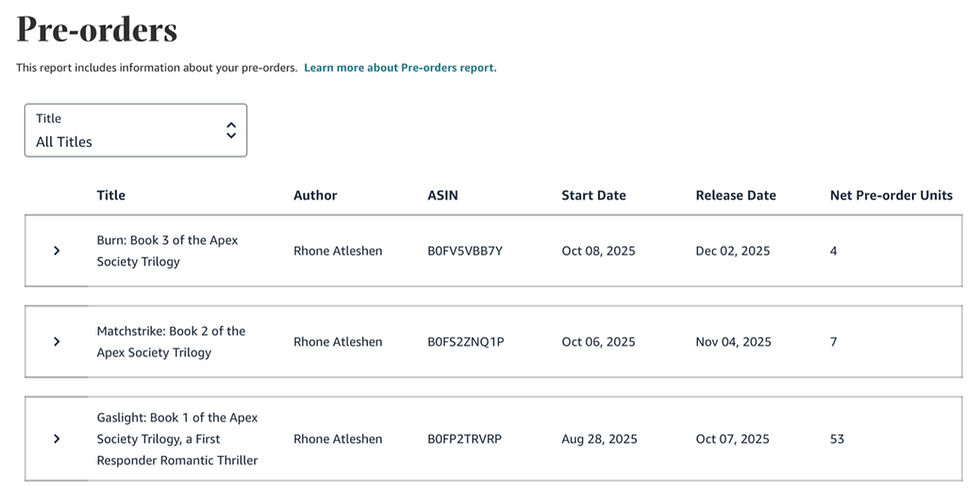
In my last post, I shared what actually happened when I published The Apex Society Trilogy over three consecutive months.
The short version?
The books launched on schedule. Readers found them. My social platforms grew. My Kindle Unlimited pages increased but my royalties remained firmly in the “that’s nice, dear” category.
If I judged the entire experiment solely by how much money entered my bank account during those three months, rapid release would be difficult to call a success. But revenue was only one of the things I was attempting to build. I was also launching a new pen name, establishing an author brand, introducing an interconnected trilogy, and trying to convince complete strangers to take a chance on books by someone they had never heard of.
Rapid release did help with those things.

A debut novel generally creates one primary launch event. You announce the cover. Open preorders. Share excerpts. Introduce the characters. Celebrate release day. Then the initial excitement settles, and the author must find ways to keep talking about the same book without beginning every post with, “Hello again. Please observe that I still have a book.”
Rapid release gave me three separate launches.
When Gaslight arrived in October, I introduced readers to Moira, Chase, and the larger threat of the Apex Society. In November, Matchstrike gave me a new couple, new tropes, new excerpts, and another reason to talk about the series. In December, Burn completed the trilogy and created a third entry point into the conversation. Each release generated fresh material while also pointing readers back toward the other books. Instead of asking one debut to sustain three months of attention by itself, I had something genuinely new to promote every month.
That did not guarantee visibility.
It gave me repeated opportunities to earn it.
Before Gaslight, Rhone Atleshen was a name without a readership. I was not simply launching a book. I was launching the pen name, website, social platforms, visual branding, newsletter, and the entire author identity surrounding it. That could easily have felt like shouting into an empty room. Rapid release gave the new platform a steady stream of activity. For three months, there was always another cover, character, trope, quote, launch milestone, or behind-the-scenes disaster to discuss. That consistency helped my social media platforms grow much faster than my royalties.
No, followers and readers are not automatically the same thing. A person watching a reel does not necessarily buy a book, and a growing follower count does not pay an editor.
Still, an audience is an asset.
By the time all three books were available, I had more than a completed trilogy. I had established the beginnings of an author platform that I could continue using for future books.
This was the most reader-focused reason behind my decision—and the part that worked exactly as intended.
I did not want readers to finish one book and wait six months for the next installment.
Partly because long waits between interconnected books are one of my personal pet peeves. Mostly because I was asking readers to remember a complex threat, multiple characters, three Wilder brothers, and whatever fresh chaos I had just inflicted upon everyone.
By the end of December, the entire trilogy was complete and bingeable.
That mattered even more for readers who discovered the series after launch. They did not encounter an unfinished story or wonder whether an unknown indie author would eventually deliver the ending.
AND THE HIGH POINT OF ALL THIS IS....
By December 29, the trilogy had accumulated 19,144 Kindle Unlimited page reads:
Gaslight: 9,694 pages
Matchstrike: 5,112 pages
Burn: 4,338 pages
Those numbers were not enormous, but page reads appeared across all three books.
Readers were not only opening the first installment. Some were continuing into the second and third.
That is the fundamental promise behind a rapid-release strategy: one book introduces the reader to the series, and the remaining books are immediately available to continue the relationship.
The page-read totals decreased with each installment, as series read-through generally does, but they demonstrated that the pathway existed. Once readers entered the Apex Society, some of them did, in fact, binge their way out. and Yes, I cannot prove that Amazon’s algorithm sprinkled magical discovery dust over my trilogy every time I uploaded another book.
What I can say is that every release created renewed activity around the series. Every new graphic, excerpt, interview, social post, and release announcement created another opportunity for someone to discover the previous books.
That ripple effect was one of my original goals.
One book did not have to carry the entire burden of launching an unknown author. The books could support one another while giving readers multiple covers, couples, and sets of tropes through which to enter the series.
The Deadline Prevented Endless Tinkering
Rapid release also forced decisions. There was no room to spend another four months changing one sentence, reconsidering a chapter title, or wondering whether a rose should move three millimeters to the left. That pressure was brutal, but it was also effective. The books could not remain private projects that I polished indefinitely while waiting to feel completely ready.
They had deadlines.
They became products.
They went into the world.
It Created a Foundation Rather Than a Windfall
This is where judging rapid release only by those first three months would create an incomplete—and unfair—picture. The immediate royalties were nominal. The long-term results have been considerably stronger.
So far this year, The Apex Society Trilogy has generated 204,038 Kindle Unlimited page reads, and my total book sales have reached 14,352. Gaslight now has more than 100 Amazon reviews and has reached #1 in its Amazon categories three separate times this year. Those results did not happen automatically because I released three books quickly. They came from continuing to market, advertise, experiment, learn, and promote the trilogy after launch season ended.
But rapid release gave me something substantial to work with.
The marketing team that helped launch the series also left me with viable social media platforms rather than three books floating alone in the digital wilderness. I could then use those platforms to practice new advertising skills, test different hooks, identify which audiences responded, run promotions, and gradually improve my ability to connect the books with readers.
Some campaigns worked.
Some emphatically did not.
But every experiment pointed readers toward a complete trilogy rather than a single book with nowhere else for them to go. That changed the economics of every successful promotion. When an advertisement or free-book campaign brought someone to Gaslight, that reader could continue into Matchstrike and Burn. A single discovery had the potential to produce three sales, three books’ worth of Kindle Unlimited pages, and—eventually—a returning reader.
Rapid release did not create the success by itself.
It gave me the foundation upon which I could create it.
⭐ Craft the story.
Face the consequences.
NEVER STOP READING!
— Rhone
Join my newsletter for future books, publishing experiments, and the occasional honest accounting of my mistakes.
As an Amazon Associate, I earn from qualifying purchases, no cost to you.


Comments