


SERIES: Rapid Release Theory
Two Truths and a Lie About Publishing Three Books in Three Months
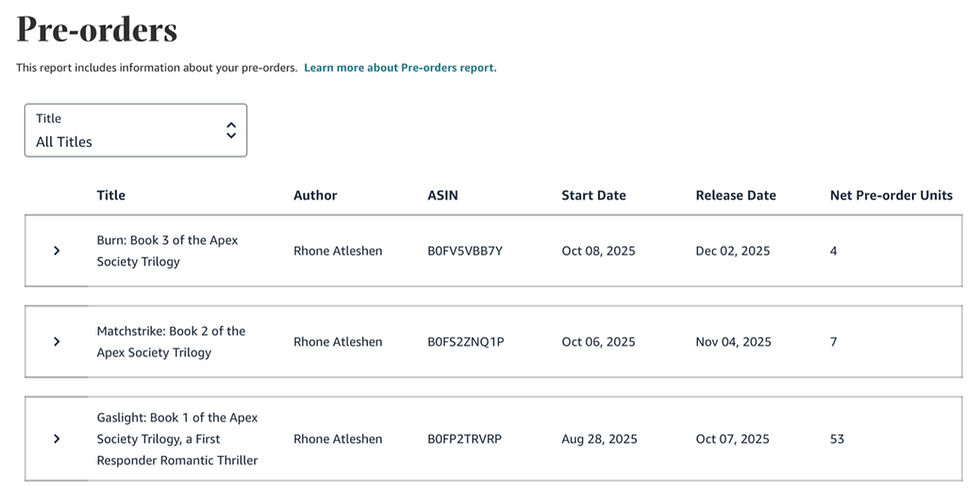
When people hear that I released three books in three consecutive months, they tend to picture me writing at an unhinged pace—finishing one manuscript, throwing it onto Amazon, and immediately racing toward the next deadline.
That is not what happened.
The releases were rapid. The writing & preparation were not.
In fact, I had written the entire Apex Society Trilogy approximately a year before Gaslight reached readers. Each book took me about 45 days to complete from beginning to finished rough draft. I wrote Gaslight, then Matchstrike, and finally Burn, taking the trilogy from beginning to end (at least the rough draft end) before committing to a publication schedule.
Then I walked away for a bit.

I attended writing conferences, refined my query materials, pitched the books to various editors, and spent a frankly ridiculous amount of time debating whether I wanted to publish under a pen name at all. And before you think that period was wasted time, let me clarify. It helped me understand what the books were, where they belonged, and what kind of author identity I wanted. I wasn't new to publishing, but having undergone a rather traumatic life shift, I needed to honor that shift in my creativity too and as such, the penname became part of the process here.
But once I finally pulled the trigger in February of 2025, the debate was over–Rhone Atleshen was officially happening and The Apex Society was launching.
From February until Gaslight launched in October, I moved the trilogy through
editing
cover design
interior layout
production
premarketing
By August, I had begun actively introducing the new pen name and books to readers via marketing and social media and (with the help of a killer hard working team) the launch went off without a hitch.
But not without some SERIOUS elbow grease...and Xanax. In fact, the phrase Rapid Release is a bit of a misnomer, and as such I thought it would be fun to play a bit fo two truths and a lie.
Truth #1: Rapid Release Requires the Books to Exist
Could someone draft and publish three novels in three months? Probably.
Would I recommend building a debut trilogy that way? Absolutely not.
Before Gaslight launched, all three rough drafts were complete. I knew the full Apex storyline, each couple’s arc, how the threat escalated, and where the trilogy ultimately ended.
That mattered because these weren’t three unrelated standalones.The larger story continued across the entire trilogy. Choices made in Gaslight affected Matchstrike. Changes made to Matchstrike could affect Burn. A continuity adjustment in one manuscript had the potential to roll downhill through everything behind it.
Which brings me to the second truth.
Truth #2: You Will Be Managing Several Books at Once
Traditional advice often treats publishing like a clean assembly line:
Rapid release does not work that way.
At one point, I was editing one book, designing another, and marketing two books at any given time. While one manuscript was with an editor, I could be reviewing cover concepts for another. When revisions came back on Book One, those changes sometimes had to be checked against Books Two and Three. Meanwhile, marketing materials needed to be created for titles that were still moving through production and my brain was FRIED at the end of each day.
It became a snowball...to hell...on fire...uphill
There was no single project sitting neatly on my desk. There were three interconnected books occupying different production stages simultaneously, plus an entirely new author platform that also had to be built, branded, and fed content and no way in hell could I have DRAFTED a new book during all that time.
Rapid release required me to stop thinking like the writer of one manuscript and start thinking like the publisher of a product line. Engaging the other parts of my brain was good, but stretching and intensely necessary.
I learned alot, including how to f*ck it all up.
Which brings me to the lie -- the great myth about Rapid Release.
The Lie: Rapid Release Means Publishing Is Faster
Rapid release describes what the reader sees. From the outside, it looked fast. Behind the scenes, the process had begun long before the first release date appeared on Amazon. The trilogy had already been written. The editing schedule had been coordinated. Covers were being developed. Formatting and distribution decisions were underway. Marketing began before readers had ever heard the name Rhone Atleshen.
The public release schedule lasted three months, but the work required to make that schedule possible stretched across far more than three months—and involved more overlapping deadlines than I had fully appreciated when I started.
That doesn’t mean rapid release was the wrong decision. It means the word rapid can be misleading.
The books didn’t need to be written rapidly. They needed to be prepared deliberately, with enough lead time to absorb revisions, design decisions, continuity problems, and inevitable delays. And even with that preparation, releasing one book per month was…a lot.
In hindsight, one month between releases may have been a little too aggressive. Just ask my editor, designer, and marketing creator who were drug on this manic ride with me.
But that particular lesson deserves its own post.
For now, the takeaway is simple:
Rapid release is not a shortcut through publishing. It is a compressed public schedule supported by a long private runway.
Readers saw three first Tuesdays.
I saw a talented team that never stopped moving.
The releases were rapid.
The preparation was anything but.
⭐ Craft the story.
Face the consequences.
NEVER STOP READING!
— Rhone
Join my newsletter for future book updates, and visit my Amazon Author storefront for funsies.
Disclosure: As an Amazon Associate, I earn from qualifying purchases.


Comments